Five screens, one job: know where you stand.
Every screen answers a positioning question. Which side of the big anchors is price on? What settled yesterday? What is testing a line right now? The platform does the computing and the bookkeeping; the judgment stays yours.
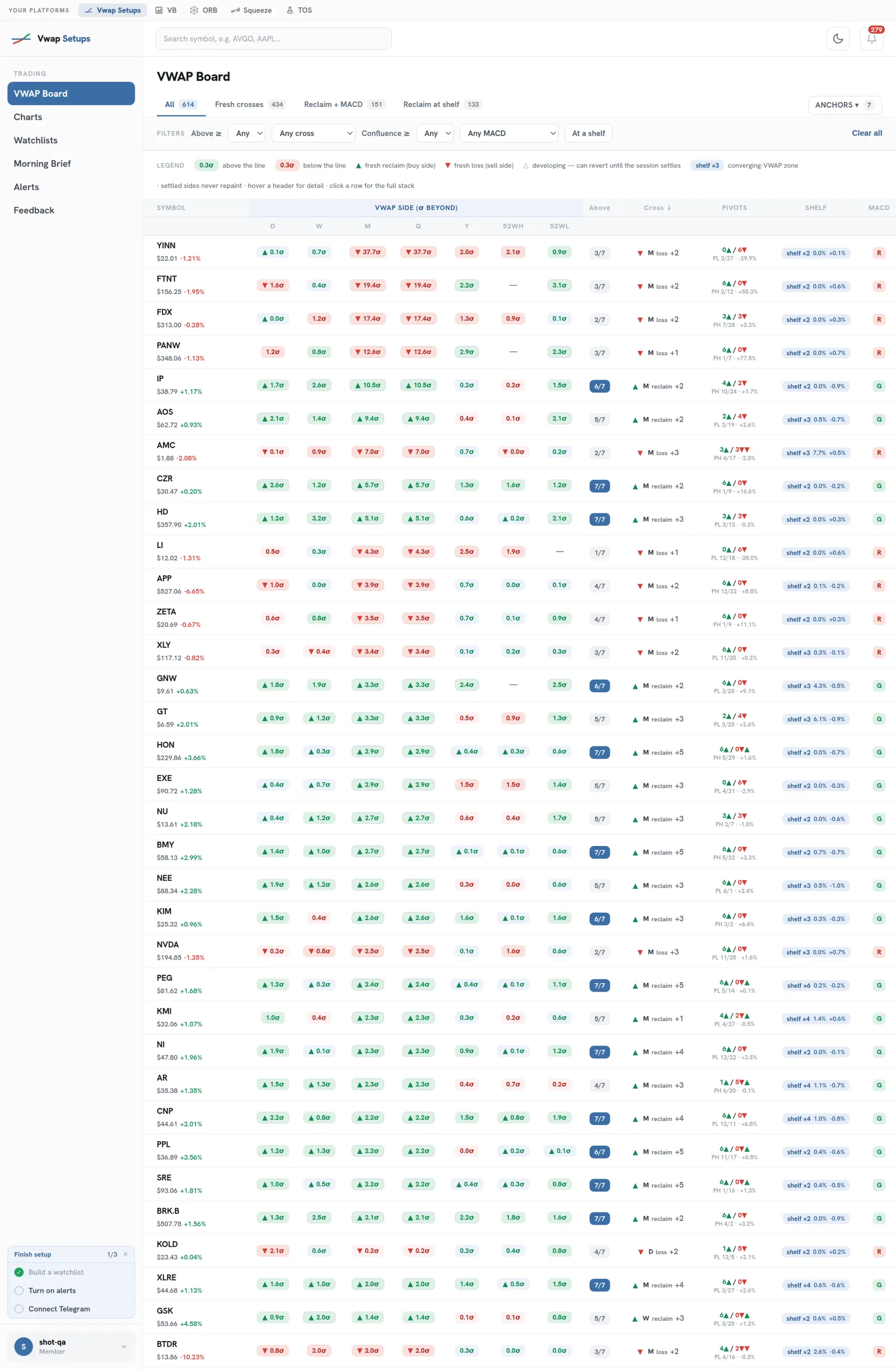
614 symbols, every anchor, one grid.
Each row is a symbol's full anchor stack: sigma position on daily through 52-week anchors, the above count, the freshest cross, pivot lines with distance, converging shelves, and the Smarter-MACD agreement column.
- Preset tabs — fresh crosses, reclaim + MACD, reclaim at shelf.
- Filters — side, cross type, confluence, MACD state, at-a-shelf.
- Legend honesty — developing marked as developing, settled never repaints.
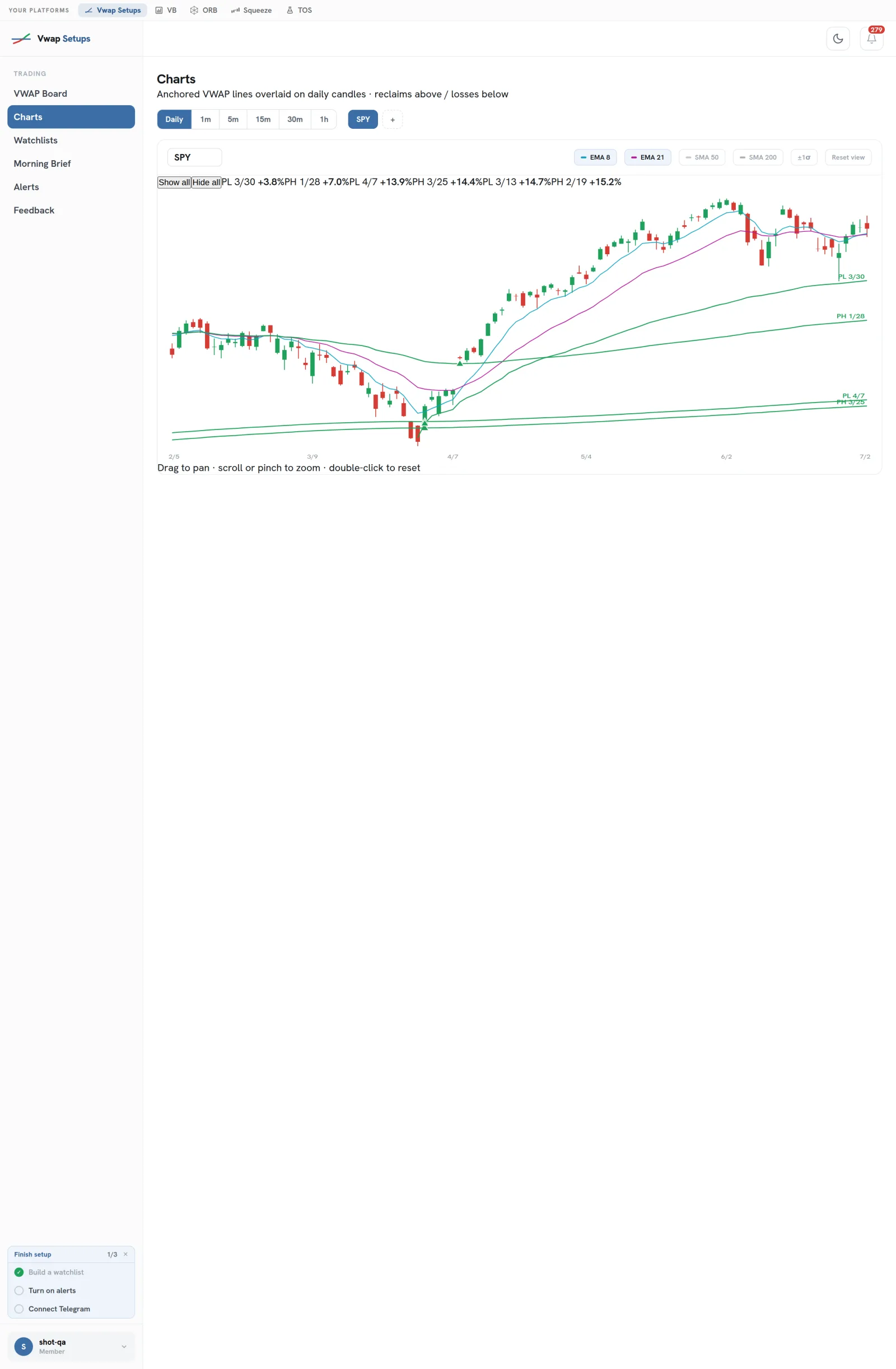
Every line on price, without the spaghetti.
Daily charts overlay the anchored lines with a smart legend: each line is a chip showing its side and distance, sorted nearest first, with far-away lines hidden by default. Intraday views anchor the session VWAP at the open with ±σ bands.
- The price ladder — every anchored VWAP on one vertical axis, support below in green, resistance above in red, shelves bracketed.
- Six views — daily plus 1m/5m/15m/30m/1h intraday.
- Pan and zoom — drag, wheel, pinch; double-click resets.
Yesterday's verdicts, before today's open.
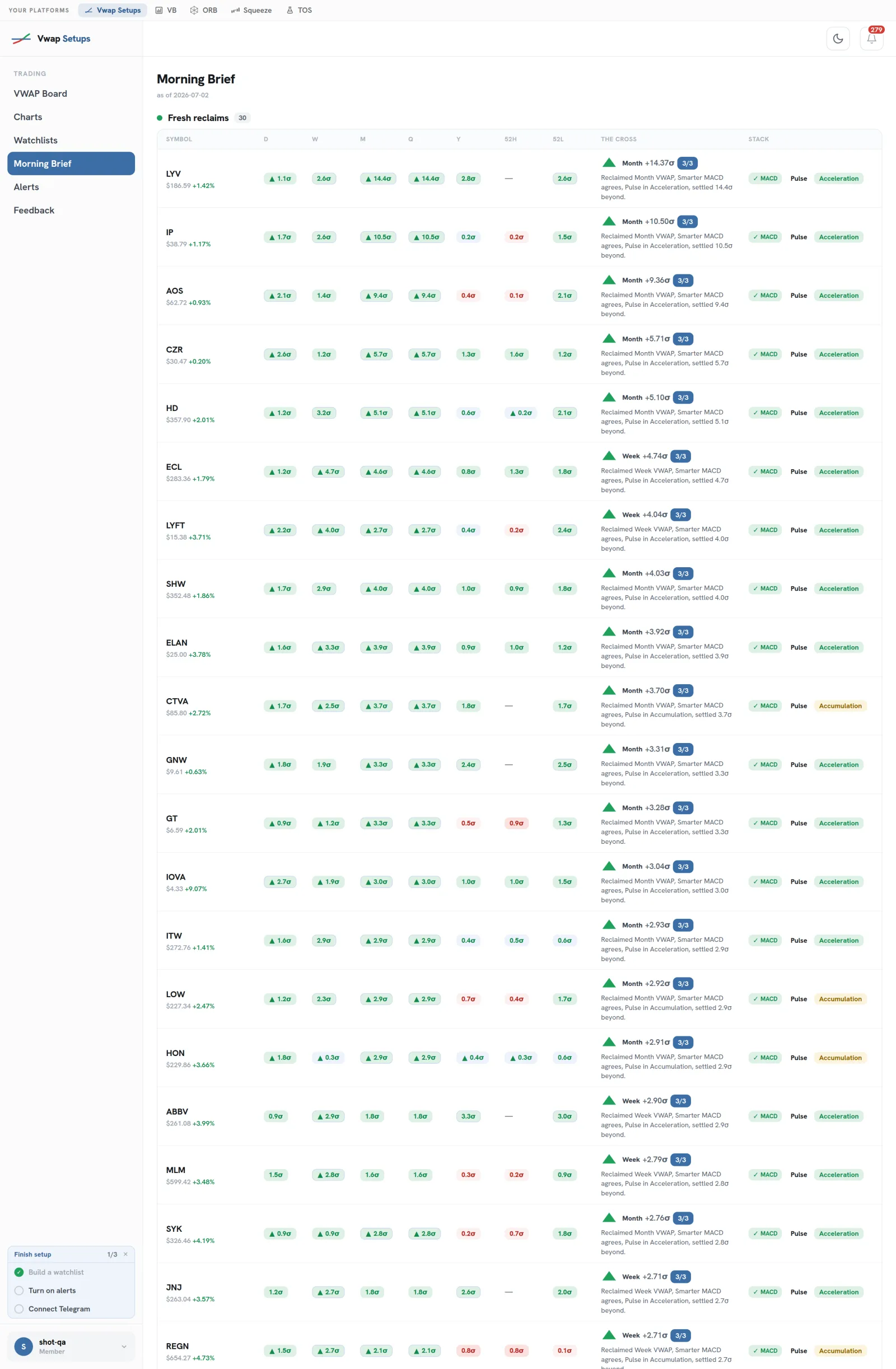
The brief lists every fresh settled reclaim and loss from the last session, ranked by the confluence stack: does Smarter MACD agree, is Market Pulse constructive, and is price at least a full sigma onto its new side? Three checks, zero to three points, no mystery.
- Reclaims and losses in separate columns, buy side and sell side.
- Confluence-ranked so the strongest crosses read first.
- One click to the symbol's board row and chart.
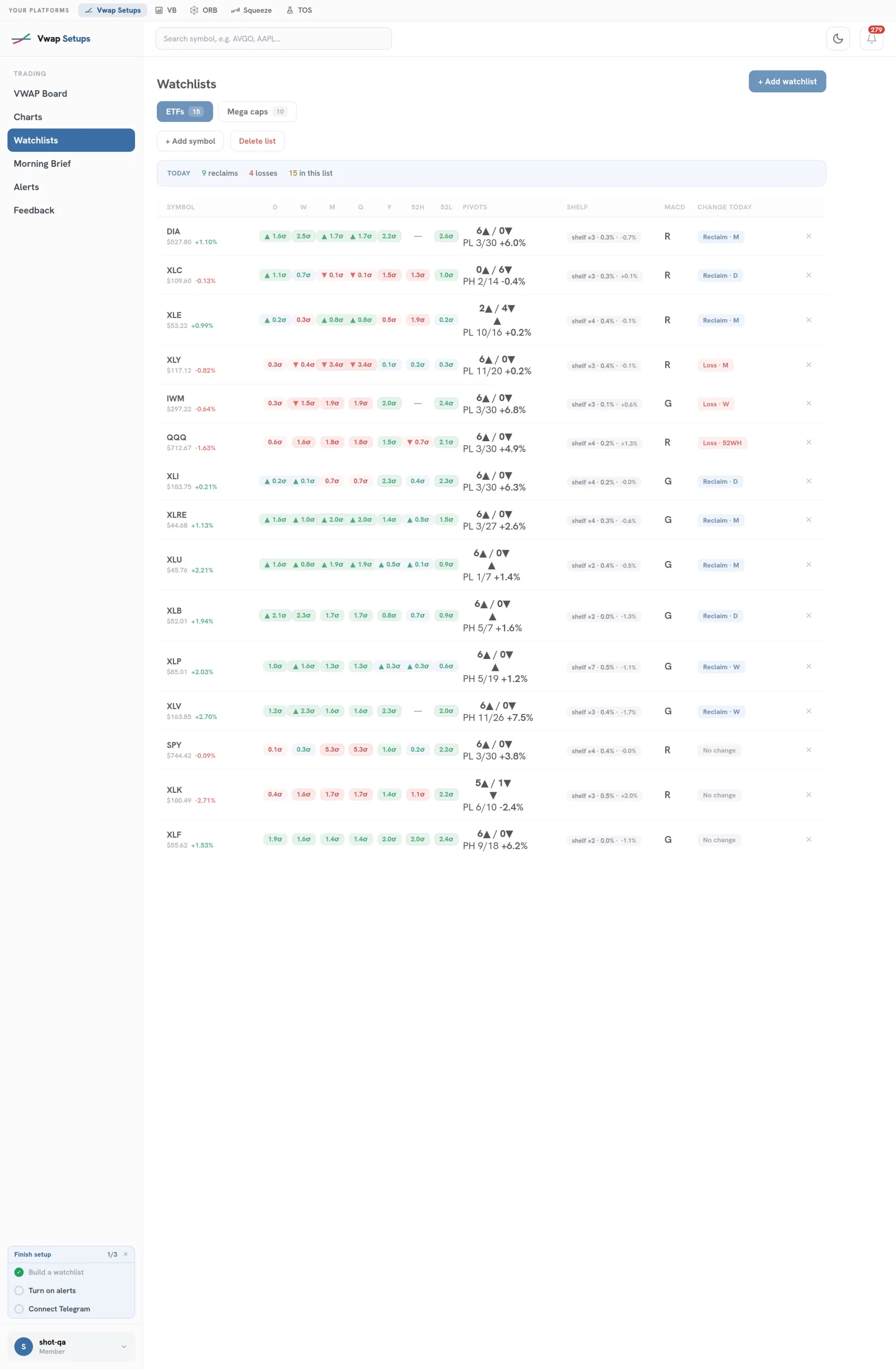
Your book, sorted by what is at a line.
Watchlists carry each symbol's anchor stack and sort by what needs attention: names testing an anchor or shelf first, quiet names last. Load a list onto the board as a filter, or point alert rules at it.
- Anchor context per row — side, sigma, freshest cross.
- One click scopes the board to a list.
- Alert rules can target a list instead of one symbol.
Rules, not noise.
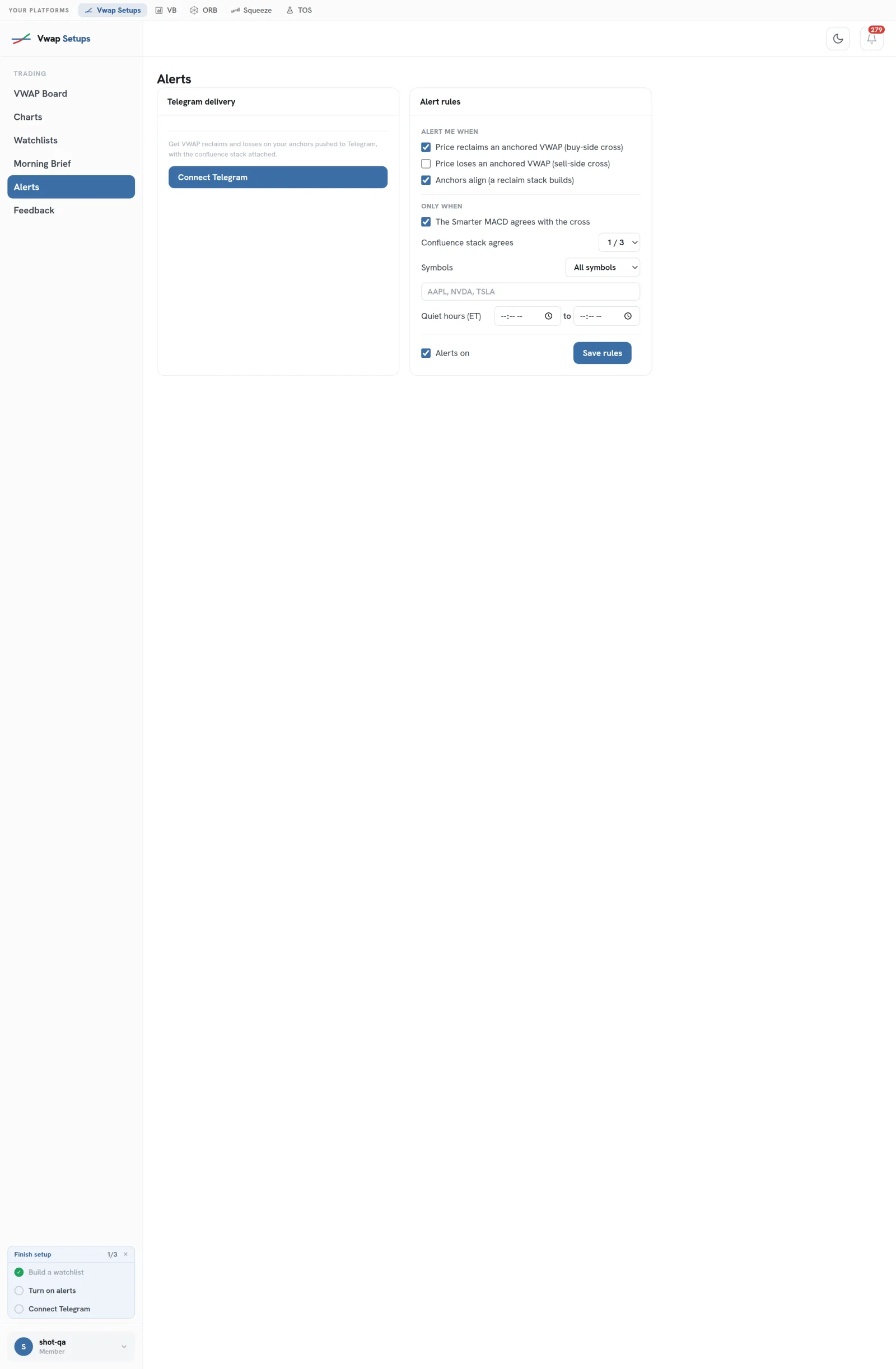
Alert on fresh settled reclaims or losses, filtered the way you actually trade: require the MACD column to agree, set a minimum confluence stack, scope to a watchlist, and set quiet hours. Delivery by Telegram or email, with the in-app feed as the record.
- Reclaim and loss triggers on any anchor.
- Confluence filter — require 0–3 of the stack to agree.
- Immediate or digest frequency, per rule.
The record is the product.
Standard typical-price math, a two-layer settled/developing model, and an append-only cross history. Nothing repaints, nothing is predicted, and every number can be recomputed by hand.
Measured, not opined
An anchored VWAP is arithmetic on price and volume. The platform's job is doing that arithmetic everywhere, honestly.
Two layers, labeled
Developing intraday, settled at the close. The distinction is visible on every row and never blurred.
Confluence, counted
The stack score is a transparent 0–3 count — MACD agrees, Pulse agrees, a full sigma onto the new side.
Know where you stand. On everything.
Every anchored VWAP on every symbol you trade, refreshed all session.